How Does an Audio Compressor Work Key Parts Types and Uses in Music Production

A great mix often feels steady, powerful, and controlled. The vocal sits in front. The bass stays even. The snare hits hard without hurting the ears. One of the main tools behind that control is compression.
An audio compressor turns down sound when it gets too loud. That simple idea has many creative uses. It can smooth a vocal, add punch to drums, tighten a bass guitar, protect a live sound system, or glue a whole mix together.
At first, compression can feel confusing because the controls use technical names like threshold, ratio, attack, and release. Once those controls connect to what the ear hears, the tool becomes much easier to use.

What an audio compressor actually does
An Audio Compressor reduces the dynamic range of a signal. Dynamic range means the difference between the quietest and loudest parts of a sound.
Think of a singer recording a verse. Some words may be soft, while others jump out. Without compression, the quiet words can disappear and the loud words can poke out too much. A compressor listens to the signal and turns down the loud parts when they cross a chosen level.
After that, the overall sound can be raised with makeup gain. The result is often a signal that feels more even and easier to place in a mix.
Compression can be subtle or obvious.
Subtle compression might make a vocal feel naturally controlled. Heavy compression might make drums sound aggressive, dense, and energetic. Both approaches are valid, as long as they serve the song.
The key parts of a compressor
Most compressors share the same core controls, whether they are hardware units or software plugins. The layout may change, but the basic logic stays the same.
Threshold decides when compression starts
The threshold is the level where the compressor begins working.
If the signal stays below the threshold, the compressor does little or nothing. When the signal rises above it, the compressor reduces the level based on the ratio setting.
A high threshold catches only the loudest peaks. A low threshold compresses more of the performance.
For example, on a vocal track, a higher threshold might only tame sudden loud phrases. A lower threshold might control nearly every word, giving a more even but less natural sound.
Ratio decides how much compression happens
The ratio controls how strongly the compressor turns down sound above the threshold.
Common ratios include:
2:1
Gentle compression for vocals, acoustic instruments, and mix bus work
4:1
Medium compression for vocals, bass, guitars, and drums
8:1 and higher
Strong compression for aggressive effects or peak control
20:1 or higher
Limiting, which stops peaks more firmly
A 4:1 ratio means that when the input goes 4 dB above the threshold, the output only rises by about 1 dB above that threshold. The compressor is not removing the sound. It is reducing how far the loud part jumps forward.
Attack controls how fast the compressor reacts
The attack setting controls how quickly the compressor starts reducing the signal after it crosses the threshold.
A fast attack grabs the sound almost immediately. This can smooth sharp peaks, but it can also reduce punch.
A slower attack lets the first part of the sound pass before compression begins. This can make drums, bass, and guitars feel more lively because the initial hit remains intact.
On a snare drum, a very fast attack can make the hit feel softer. A slower attack can let the crack through, then control the body of the drum.
Release controls how fast the compressor lets go
The release setting controls how quickly compression stops after the signal falls below the threshold.
A fast release can make a track feel energetic, but it may cause pumping or distortion if set too fast. A slow release can sound smooth, but it may hold the volume down too long and make the track feel flat.
The best release time often follows the rhythm of the music. If the gain reduction meter moves in a musical way, the compressor usually feels more natural.
Knee changes how compression begins
The knee controls the transition into compression.
A hard knee starts compression sharply once the signal crosses the threshold. This can work well for drums, limiting, and precise control.
A soft knee eases into compression more gradually. This often sounds smoother on vocals, bass, acoustic guitar, and mix bus compression.
Makeup gain brings the level back up
Since compression turns down loud parts, the track may sound quieter after processing. Makeup gain raises the level after compression.
This is where beginners can get tricked. Louder often sounds better, even when it is not. To judge compression fairly, compare the compressed and uncompressed signal at a similar volume.
If the compressed version only sounds better because it is louder, the settings may not actually be improving the mix.
The detector or sidechain listens to the signal
Inside a compressor, the detector circuit decides when and how the compressor reacts. Many compressors use a sidechain, which is a control path that tells the compressor what to listen to.
In normal use, the compressor listens to the same signal it is processing. In external sidechain use, one sound can trigger compression on another sound.
A common example is dance music sidechain compression. The kick drum triggers compression on a bass or synth pad, making it dip every time the kick hits. This creates space and gives the track a pumping groove.
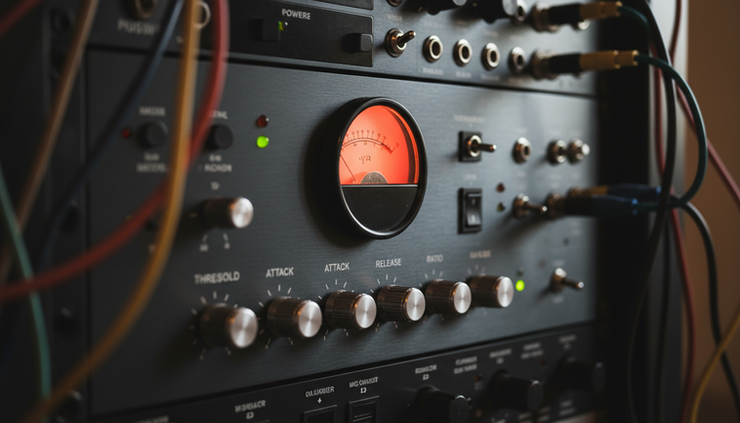
How compression changes the sound
Compression is not just volume control. It can change the tone, movement, and emotion of a performance.
It controls peaks
Peaks are short loud moments. A compressor can catch them before they dominate the mix. This helps engineers keep a vocal, snare, or bass track under control without manually adjusting every loud note.
It increases perceived loudness
When loud peaks are reduced, the overall track can be raised. This makes the quieter details more audible.
That is one reason compressed vocals often feel closer and more present. Breath, tone, and small details come forward.
It shapes punch and sustain
Attack and release settings affect the shape of a sound.
A slower attack can make drums punchier because the transient gets through. A faster attack can soften the transient and bring up the body of the sound. On bass, compression can even out note volume and add sustain.
It adds character
Some compressors are loved because they color the sound. They may add warmth, thickness, brightness, grit, or smoothness.
A clean digital compressor can control levels without much tone change. A vintage-style tube compressor might add harmonic richness. Neither is automatically better. The right choice depends on the source and the goal.
Why compressors matter in music production and sound engineering
Compression shows up almost everywhere in audio work. It is used in recording, mixing, mastering, live sound, podcasting, broadcasting, and film post-production.
In music production, compressors help parts fit together. A lead vocal can stay clear over a dense arrangement. A bass guitar can sound stable on small speakers. Drum rooms can become explosive. A mix bus can feel more connected.
In sound engineering, compression also solves practical problems. Live engineers use it to control sudden vocal jumps and protect speakers from extreme peaks. Podcast editors use it to keep speech comfortable from one sentence to the next. Broadcast chains use compression and limiting to maintain consistent levels.
Compression is also important because human performances are dynamic. That is a good thing. A singer should not sound like a robot, and a drummer should not hit every note with the same force. The compressor does not need to erase expression. Used well, it keeps the emotion while controlling the extremes.
Common types of compressors and where they work best
Different compressor designs react in different ways. Some are clean and fast. Some are slow and smooth. Some add obvious color.
Compressor type | Sound and behavior | Common uses |
VCA compressor | Fast, controlled, precise | Drums, mix bus, live sound, punchy control |
FET compressor | Very fast, bold, aggressive | Rock vocals, drums, parallel compression |
Optical compressor | Smooth, musical, slower response | Vocals, bass, acoustic instruments |
Vari-mu compressor | Warm, thick, tube-like character | Mix bus, mastering, gentle glue |
Digital compressor | Flexible, clean, highly adjustable | Any source, surgical control, transparent mixing |
Multiband compressor | Compresses separate frequency ranges | Mastering, vocals, bass, problem control |
Limiter | Very high ratio, catches peaks | Master output, broadcast, peak protection |
VCA compressors are clean and punchy
VCA stands for voltage-controlled amplifier. These compressors are known for speed, accuracy, and control.
They work well when a track needs firm handling without too much color. Many engineers use VCA-style compressors on drums, bass, and the mix bus. They can make a drum bus feel tight and energetic.
FET compressors are fast and exciting
FET compressors react very quickly and often add attitude. They are popular on rock vocals, snare drums, room mics, and parallel drum tracks.
A FET compressor can make a vocal sound urgent and upfront. On drums, it can bring out aggression and energy. Used too heavily, it can sound gritty or smashed, which may be perfect for some styles and too much for others.
Optical compressors are smooth and natural
Optical compressors use a light-based control system. In simple terms, the audio signal affects a light source, and a sensor reacts to that light. This creates a smooth response that often feels musical.
Optical compression is a classic choice for vocals and bass. It can level out a performance without sounding too obvious.
Vari-mu compressors add warmth and glue
Vari-mu compressors use tube circuitry to reduce gain. They often respond gently and add harmonic color.
These compressors are common on mix bus and mastering chains when the goal is subtle glue rather than heavy control. They can make a mix feel slightly thicker and more polished.
Digital compressors are flexible and precise
A modern Audio Processing Plugin can offer clean compression, vintage models, sidechain filters, visual meters, automatic timing, and multiband control.
Digital compressors are useful because they can be transparent or colorful. They also make it easy to save settings, compare versions, and use several compressors in a session without owning hardware.
Practical examples of compression in a mix
Compression becomes easier to understand when tied to real mix problems.
Vocals need consistency without losing emotion
A vocal often needs light to medium compression so words stay clear. Try a moderate ratio, medium attack, and release that returns to zero between phrases.
For a natural vocal, avoid crushing every syllable. Aim for a few dB of gain reduction on louder words. For pop, rock, or hip-hop, stronger compression may help the vocal stay upfront.
Drums need punch, weight, or energy
On a kick or snare, attack time matters a lot. A slower attack can keep the hit sharp. A faster attack can smooth the transient and bring up body.
Parallel compression is also popular on drums. This means blending a heavily compressed drum signal with the original. The dry signal keeps the punch, while the compressed signal adds density and excitement.



Comments