Modular Music Tech Breakthroughs Squarp Core Swayed 1 1 and Filter Blender

Modular music gear is moving in a clear direction: fewer dead ends, more conversation between machines, and more ways to shape sound without staring at a screen. The newest tools are not just adding features. They are solving common studio problems, like getting a hardware sequencer to speak to an analog rig, bringing a classic digital synthesizer into a modern workflow, or making a filter feel less like a fixed effect and more like an instrument.
Three recent products show that shift well: Squarp Instruments Core, Stryde Audio Swayed 1.1, and UB DSP Filter Blender. Each one tackles a different part of the production chain.
Core focuses on control and routing. Swayed 1.1 revisits one of Yamaha’s most ambitious digital synthesizers. Filter Blender turns analog filtering into a more fluid sound-shaping process.
Together, they point to a useful trend: modular music technology is becoming more flexible without losing the hands-on feel that makes it exciting.
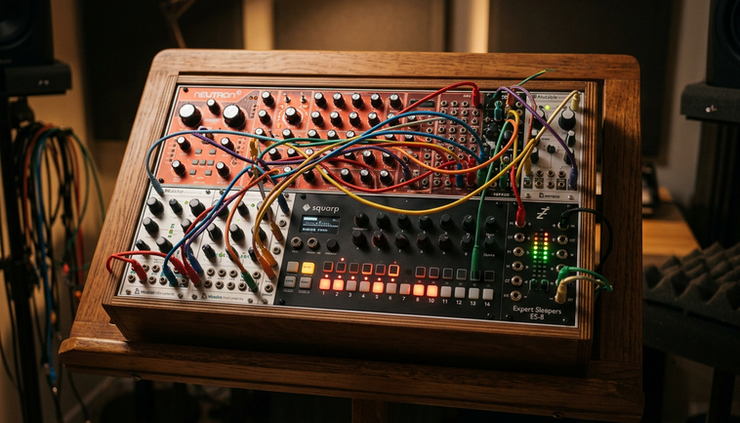
Squarp Instruments Core brings smarter control to modular setups
Squarp Instruments has built its reputation around sequencing and hardware control. Core fits that larger idea, but approaches it through a very practical need: translating digital music commands into the electrical signals used by modular synthesizers.
At the center of Core is its role as a Musical Instrument Digital Interface to control voltage and gate converter. That phrase sounds dense, so here is the plain version.
Most keyboards, grooveboxes, and software tools send musical information as digital messages. Modular synthesizers often respond to electrical voltage. A changing voltage can control pitch, filter movement, volume, or another parameter. A gate signal is simpler. It turns something on or off, often to start a note or trigger a sound.
Core sits between those worlds. It receives digital note and control messages, then translates them into the voltage and trigger signals a modular system can use.
That matters because many producers work across both worlds now. A beat might begin in a computer. A bass line might come from a hardware sequencer. Texture might come from a Eurorack case. Without a capable converter, each part can feel isolated. With one, the setup starts to behave like one instrument.
Built-in generative engines add controlled surprise
Core’s built-in generative engines are a key part of its appeal. In music gear, generative tools create patterns or variations using rules. They do not simply play a fixed loop forever. They can add controlled randomness, variation, probability, or evolving movement.
For example, a producer might send Core a basic note pattern, then let a generative engine create changing rhythms from it. Another patch might use generative voltage movement to open and close a filter in a way that feels less repetitive than a hand-drawn automation lane.
The value is not randomness for its own sake. The value is repeatable surprise. A good generative system lets the producer set boundaries, then produces useful results inside those boundaries. That can keep a modular patch alive during a long recording pass.
This is especially useful in modular work because small changes can produce big musical results. A slightly different gate pattern can turn a simple sequence into a rolling percussion part. A slowly shifting control signal can make a drone feel animated instead of static.
Intelligent routing reduces cable and menu friction
Core also highlights intelligent routing, which is one of the most important areas of modern modular music technology. Routing is the path a signal takes. In older setups, changing that path often meant repatching cables, changing device settings, or rebuilding a track from scratch.
With smarter routing, signals can move between sources and destinations with more intention. A keyboard can control one voice while a sequencer controls another. A computer can send clock information, which keeps timing aligned, while hardware sends notes. A controller can adjust several modular destinations at once.
A simple example makes the benefit clear. Imagine a live setup with three sources:
A hardware sequencer sending bass notes
A computer sending tempo and arrangement cues
A pad controller sending filter movement
A basic converter might force compromises. Core’s signal merging and routing approach lets those streams work together instead of competing for the same lane.
Dual USB ports matter more than they sound
Core’s dual Universal Serial Bus ports may look like a convenience feature, but they are central to how modern studios work. Many current instruments, controllers, and computers use Universal Serial Bus connections to send timing, notes, and control data.
Two ports give Core more room to act like a hub rather than a simple adapter. One port can connect to a computer or tablet. The other can connect to a controller, sequencer, or another digital instrument. That layout can reduce the need for extra boxes in the middle of a setup.
The bigger feature is multi-stream signal merging. This means Core can combine several incoming musical streams into one usable output plan. In practice, that can make hybrid setups feel less fragile.
Instead of asking one device to do everything, producers can let each tool do its best job. A computer can handle arrangement. A hardware box can handle hands-on sequencing. A modular case can handle sound generation. Core helps those parts meet in the middle.

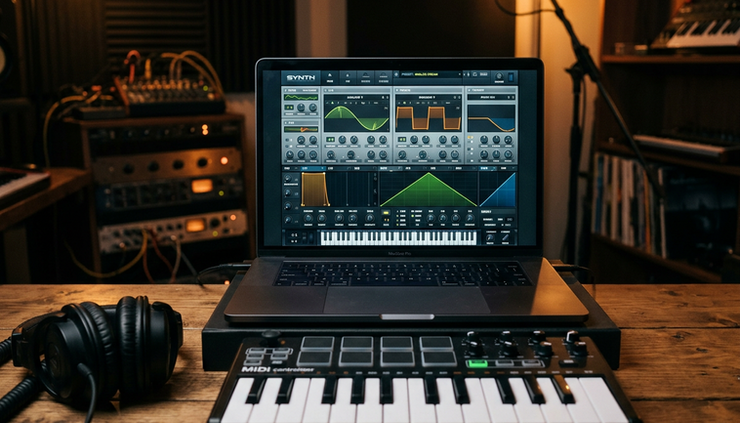
Stryde Audio Swayed 1.1 brings the Yamaha SY77 idea into software
Stryde Audio Swayed 1.1 takes a different route. Instead of solving hardware routing, it focuses on a classic digital synthesizer sound. Its central idea is a software emulation of the Yamaha SY77, a synthesizer widely known for combining frequency modulation synthesis with sample-based sound sources.
Frequency modulation synthesis creates sound by using one waveform to change another at audio speed. That can produce glassy keys, metallic tones, bells, growling basses, and complex digital textures. Sample-based synthesis uses recorded sound waves as the starting point. The SY77 stood out because it brought these approaches together in a deep, programmable instrument.
A software emulation can make that style easier to use in a modern studio. Instead of maintaining older hardware, dealing with aging buttons, or routing external audio, producers can load the sound engine inside a recording program and automate it like any other software instrument.
That alone is useful, but Swayed 1.1 becomes more interesting because of its Custom Waveform Read-Only Memory Editor.
The Custom Waveform ROM Editor changes the starting point
Read-Only Memory, often shortened to ROM, usually means stored data that the user does not freely rewrite in everyday use. In a classic synthesizer context, waveform memory holds the raw wave shapes or short sampled sounds that feed the sound engine.
A Custom Waveform ROM Editor changes what producers can treat as a starting material. Instead of relying only on the original-style waveform set, a producer can shape or manage custom waveform content within the instrument’s system.
That has a large creative impact. The character of a digital synthesizer often begins at its source waveforms. If those sources change, the whole instrument changes. A bright waveform may lead to sharp digital keys. A rougher waveform may create aggressive basses. A vocal-like waveform may turn into pads with a human edge.
For producers, this means Swayed 1.1 is not just a nostalgia tool. It can borrow the structure of a classic Yamaha-style instrument, then feed that structure new material.
Why this matters for modern producers
The Yamaha SY77 was known for depth, but depth can become friction. Older digital synthesizers often require menu-heavy programming. Software can make the same type of sound design more direct through larger displays, preset management, automation, and project recall.
Swayed 1.1 also fits a common production pattern: build complex tones in software, then pair them with hardware processing. A producer might create a bright digital pad in Swayed, send it through an analog filter, then sample the result back into a track. Another might layer a metallic Swayed pluck with a modular bass sequence controlled through Core.
The key point is compatibility. Software instruments now need to do more than imitate the past. They need to fit into a studio where hardware, modular systems, and recording software all share the same session.
Swayed 1.1 appears aimed at that exact space: classic digital tone, modern editing, and new source material through the waveform editor.
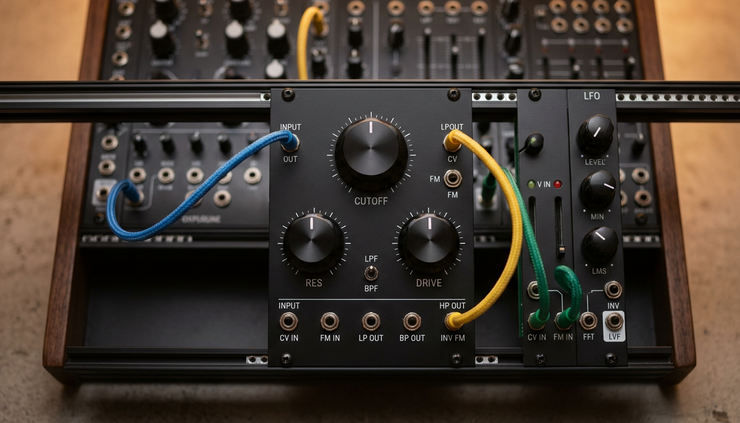
UB DSP Filter Blender makes analog filtering more fluid
Filters are central to electronic music. A filter removes or emphasizes parts of a sound. The most familiar type is a low-pass filter, which lets low frequencies through and reduces high frequencies. That is the classic move behind many warm bass lines and sweeping synth pads.
UB DSP Filter Blender builds on that familiar idea with triangular analog filter interpolation. The word interpolation means moving smoothly between points. In this case, the concept is to blend between three filter behaviors arranged like the corners of a triangle.
Instead of selecting one filter type and staying there, the user can move through a field of filter responses. That makes the filter feel less like a switch and more like a performance surface.
Think of it like placing three sound colors at the corners of a triangle. Moving toward one corner gives more of that character. Moving between corners creates mixed tones. Moving through the center can create balanced shapes that a single fixed filter might not produce.
The three filter topologies give the blend its character
A filter topology is the circuit design or structure behind a filter. Different designs can share the same basic job while sounding very different. Filter Blender’s appeal comes from giving three analog filter characters a shared space.
The exact product language may describe these in its own terms, but the core idea is easy to understand through the three roles commonly found in filter design:
Filter behavior | What it does | Musical result |
Low-pass style | Lets lower tones through and reduces brighter content | Warm basses, round pads, classic synth sweeps |
High-pass style | Lets brighter tones through and reduces low-end weight | Thin textures, motion effects, space for kick drums |
Band-pass style | Focuses on a middle range and reduces content above and below | Vocal-like tones, resonant leads, tuned percussion effects |
The important part is not only that these shapes exist. Many instruments offer them. The important part is the blending method. A triangular control approach can create movement between the filter behaviors rather than forcing sudden changes.
That opens up expressive production choices. A drum loop can start with a tight midrange focus, then drift toward a brighter high-pass shape before landing in a warmer low-pass tone. A synth lead can move through changing resonant colors during one phrase. A noise source can become percussion, wind, or a textured riser depending on how the filter moves.
Analog interpolation supports performance, not just sound design
Analog filters are valued because their behavior often feels physical. They can respond to input level, resonance, and movement in ways that are hard to reduce to a simple preset. Filter Blender’s triangular interpolation gives that movement a clear performance role.
For producers, this matters in two places.
First, it helps during recording. Turning one control path can create evolving tone changes that feel intentional. That can be more musical than drawing several separate automation lines after the fact.
Second, it helps in live modular performance. A performer can move through filter states with one gesture, creating variation without repatching the system. The result can be dramatic, but the control idea stays simple.
What these tools say about where modular music is heading
These products are different, but they share a common theme: they reduce the gap between idea and sound.
Squarp Instruments Core helps devices talk to each other. It makes a hybrid setup feel less like a pile of separate machines and more like a connected instrument.
Stryde Audio Swayed 1.1 shows how software can honor a classic synthesizer while expanding its source material. The Custom Waveform ROM Editor is especially important because it changes what the instrument can become, not just how closely it can copy the past.
UB DSP Filter Blender focuses on touch and movement. Its triangular filter interpolation turns tone shaping into a continuous space rather than a list of separate modes.
The practical result is a more fluid studio. A producer can generate a pattern, route it into modular hardware, create a deep digital layer in software, then shape the whole mix through a moving analog filter. Each step keeps its own character, but the workflow becomes more connected.
That is the real advance. New gear is not only becoming more powerful. It is becoming better at staying out of the way when a musical idea appears.
FAQ
What does a MIDI-to-CV/Gate converter do?
It translates digital music messages into control voltage and gate signals that modular synthesizers can understand. Control voltage can change pitch or movement. A gate signal usually starts or stops a note or event.
Why are dual USB ports useful on Squarp Instruments Core?
Two Universal Serial Bus ports can connect more than one digital device at the same time, such as a computer and a controller. This supports more flexible routing and makes it easier to merge several musical signal streams.
What makes Swayed 1.1 different from a basic Yamaha SY77-style plugin?
Its software emulation focuses on the SY77’s digital synthesis approach, while the Custom Waveform ROM Editor adds a way to work with custom source waveforms. That gives producers more freedom than a fixed preset-style instrument.
What is triangular analog filter interpolation?
It is a way of smoothly blending between three filter characters arranged like points on a triangle. Instead of choosing only one filter mode, the sound can move between them.
Which product is best for a beginner in modular music?
Core is the most directly useful for connecting digital gear to a modular system. Swayed 1.1 is better for software-based sound design. Filter Blender is best for shaping tone once sound sources are already in place.

The takeaway
The strongest modular tools now do more than add another sound source or effect. They help systems communicate, evolve, and respond.
Squarp Instruments Core strengthens the bridge between digital control and modular voltage. Stryde Audio Swayed 1.1 brings a classic Yamaha-style digital engine into a more flexible software space. UB DSP Filter Blender makes analog filtering feel more like a moving instrument than a fixed processor.
For producers building hybrid studios, that combination matters. The future of modular music tech looks less like isolated boxes and more like connected choices, where routing, synthesis, and tone shaping all work together.

Comments