How Long Does It Take to Learn Music Production A Beginner Guide

Most beginners can make a simple song in a few weeks. Getting consistent, polished results usually takes six months to two years.
That range is wide for a reason. Music production is not one skill. It is a bundle of skills. You learn song structure, rhythm, recording, editing, sound choice, mixing, and how to use music production software without losing your ideas.
The good news is simple. You do not need to master everything before you start. You can make real progress from day one.
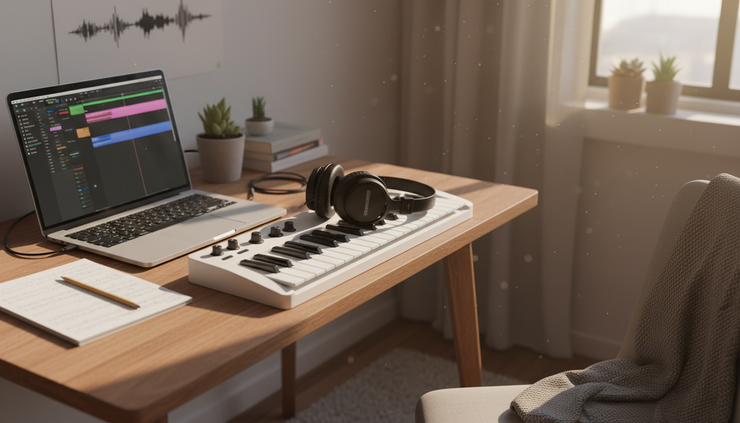
The short answer on how long it takes
Here is a practical timeline for most beginners.
Stage | Typical time | What you can do |
First steps | 1 to 4 weeks | Open the software, build a simple beat, record a sound, arrange a short idea |
Beginner level | 1 to 3 months | Finish basic songs, use simple effects, understand song sections |
Confident beginner | 3 to 6 months | Create full tracks, fix common timing issues, make cleaner mixes |
Intermediate level | 6 to 18 months | Produce songs with better balance, stronger sounds, and more control |
Advanced growth | 2 years and beyond | Build a clear style, work faster, finish music that sounds release-ready |
This timeline assumes steady practice. A person who works for 30 minutes most days will move faster than someone who studies once every few weeks.
The goal at first is not perfection. The goal is finishing. Finished tracks teach more than half-built loops.
What affects how fast you learn
Your timeline depends on several factors. Some are in your control. Others are just part of your starting point.
Prior musical experience helps
If you already play an instrument, sing, write songs, or understand rhythm, you have an advantage.
You may already know:
How chords feel
How melodies move
How songs build energy
How timing works
How to listen for mistakes
That can shorten the early learning curve. You will still need to learn the software and production choices. But the musical side will feel less confusing.
If you have no music background, that is fine. Many producers start with no formal training. Focus on simple patterns first. Learn by copying basic song structures. Build small ideas before chasing full arrangements.
Practice time matters more than talent
Talent helps, but repetition wins.
A useful practice schedule looks like this:
20 to 30 minutes on weekdays
1 longer session on the weekend
1 finished short idea each week
1 focused skill per session
Short daily practice works because music production has many small actions. You need to learn where tools are, how to hear changes, and how to make decisions without stopping every minute.
Long gaps slow you down. Each session becomes a review session. Keep the habit small if needed. Ten focused minutes is better than waiting for the perfect free afternoon.
The software can speed you up or slow you down
Music production software can feel like a maze at first. Some programs have simple layouts. Others give more control but take longer to learn.
A complex program is not always better for beginners. The best choice is the one that lets you make music without constant confusion.
Look for software that makes these tasks easy:
Create a beat
Record audio
Move sections around
Add simple effects
Export a finished song file
Do not switch software every month. That creates a new learning curve each time. Pick one and stay with it for at least three to six months.
Your goals change the timeline
Learning enough to make fun beats is faster than learning to produce polished songs for release.
These goals need different amounts of time:
Goal | Rough timeline |
Make short beats for fun | A few weeks to 3 months |
Record vocals over an instrumental | 1 to 4 months |
Produce full songs from scratch | 3 to 12 months |
Mix songs so they sound balanced | 6 to 18 months |
Build a personal sound | 1 to 3 years |
Your first goal should be small. Make a 30-second idea. Then make a 1-minute track. Then finish a full song. Each step builds confidence.
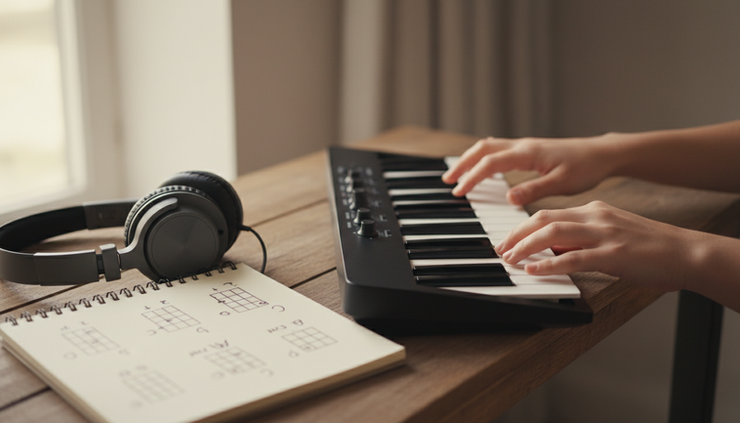
A realistic learning path for beginners
Music production becomes easier when the path is clear. Do not try to learn everything at once.
Month 1 is for basic control
In the first month, learn how to move around your software.
Focus on:
Starting a new project
Adding sounds
Recording a short part
Using a simple beat pattern
Copying and moving sections
Saving and exporting a song
Finish tiny projects. They do not need to sound great. They need to exist.
A strong first-month goal is three short tracks under one minute each.
Months 2 and 3 are for finishing songs
Now start building full arrangements.
Learn the main parts of a song:
Intro
Verse
Chorus
Break
Ending
You do not need to use those exact labels for every style. The point is movement. A song should change over time.
At this stage, beginners often make loops that never become songs. Break that habit early. Duplicate the loop, remove parts, add parts, and create contrast.
A strong three-month goal is two finished songs.
Months 4 to 6 are for better sound
After a few finished songs, your ears improve. You will notice problems.
Maybe the drums are too loud. Maybe the vocal is buried. Maybe the bass takes up too much space. This is where mixing begins.
Mixing means balancing the parts of a song so they work together. Start with simple moves:
Set volume levels
Place sounds left, right, or center
Remove sounds that clash
Use fewer effects
Compare your song to a song you like
Do not get trapped by tiny changes. A better song matters more than a perfect snare sound.
After 6 months is where style grows
Once you can finish tracks, your taste becomes the teacher.
You start asking better questions:
Why does this song feel bigger?
Why does this chorus hit harder?
Why does this vocal feel clear?
Why does my track feel crowded?
This stage lasts a long time. That is normal. Skilled producers keep learning for years.
How to learn faster without burning out
Speed comes from focus. Random tutorials and unfinished projects slow beginners down.
Practice one skill at a time
Do not sit down with the goal of “getting better at production.” That is too broad.
Use clear session goals:
Build one drum pattern
Write one bass line
Record one vocal take
Arrange one chorus
Balance five tracks by volume
Finish one 45-second idea
A small target gives the session a win.
Copy structure, not identity
Pick songs you like and study their shape. Do not copy someone else’s melody or lyrics. Study the build.
Ask simple questions:
When does the beat start?
How many sections are there?
When do new sounds enter?
When does the energy drop?
How long is the chorus?
This trains your ear and your pacing.
Finish more music than you polish
A common beginner mistake is spending three weeks on one loop. That feels productive, but it blocks growth.
Set limits.
Try this plan:
One idea per week
Finish it by the end of the week
Export it, even if it feels rough
Write down one lesson
Start fresh next week
Quantity builds judgment. After 10 finished tracks, you will hear progress.
Keep your setup simple
A beginner does not need a room full of gear.
A basic setup can include:
A computer
Music production software
Headphones
A small keyboard controller, if useful
A microphone, if recording vocals or instruments
Start with what you have. Upgrade later when you know what problem you need to solve.

Recommended resources for learning music production
You do not need to learn alone. Use resources that match your current stage.
Guided lessons
A structured course can save time because it gives a clear order. That helps beginners avoid jumping between random topics.
Look for lessons that cover:
How to use the software
Basic music building blocks
Recording
Editing
Arrangement
Mixing basics
How to finish projects
A good Music Production Course should include practice tasks, not just videos.
Software manuals and built-in lessons
Your music software likely includes help pages or built-in lessons. These are useful because they match the exact tools on your screen.
Use them when you need direct answers, such as:
How to record
How to change tempo
How to export a song
How to use a basic effect
Manuals are not exciting, but they solve problems fast.
Beginner communities
Online music communities can help when you feel stuck. Use them with care.
Ask specific questions. Share what you tried. Avoid asking, “How do I make this sound professional?” That question is too broad.
A better question is, “My vocal is hard to hear when the drums enter. What should I check first?”
Feedback from real listeners
Feedback is useful when it is clear and honest.
Ask listeners simple questions:
Which part felt strongest?
Did any part feel too long?
Could you hear the main vocal or melody?
Did the song feel finished?
Do not ask too many people at once. Too many opinions can freeze your progress.
Common beginner challenges and how to handle them
Every beginner runs into the same walls. Expect them. They do not mean you lack talent.
The software feels confusing
This is normal. Do not learn every button.
Learn only what you need for the next task. If the task is making a beat, ignore vocal recording. If the task is recording guitar, ignore advanced sound design.
Create a simple checklist for starting a project. Use it until the first steps become automatic.
Your music sounds worse than you hoped
Your taste improves before your skill catches up. That gap can feel frustrating.
Keep old projects. Listen back after a month. You will hear progress.
Do not delete everything. Finished work is proof that you are learning.
You keep starting but not finishing
Set a deadline. Lower the scope.
If a full song feels too hard, finish a 60-second version. If that feels too hard, finish four sections of 15 seconds each.
Finishing is a skill. Practice it directly.
You use too many sounds
More sounds do not always make a track better. They often make it crowded.
Start with fewer parts:
Drums
Bass
Main chords
Main melody or vocal
One extra texture
If the song works with five parts, add more only when needed.
You compare too much
Comparing your first tracks to finished commercial songs is unfair. Those songs often involve years of skill and careful work.
Use comparison for learning, not self-criticism. Pick one thing to study. Maybe the kick drum level. Maybe the chorus length. Maybe the vocal volume.
A simple weekly plan for faster progress
Use this plan if you want structure without overthinking.
Day | Focus |
Monday | Make a drum pattern |
Tuesday | Add chords or bass |
Wednesday | Add melody or vocal idea |
Thursday | Arrange the track into sections |
Friday | Balance volumes and remove clutter |
Saturday | Export the song and take notes |
Sunday | Rest or listen to references |
Repeat this for four weeks. By the end, you may have four finished ideas. They will not all be great. That is fine. The habit matters.
If you want a clearer path with guided lessons and practice projects, explore this Music Production Course.
FAQ
Can I learn music production with no music background?
Yes. Start with rhythm, simple melodies, and basic song structure. Learn by making short tracks. Formal training helps, but it is not required.
How many hours a week should I practice?
Aim for 3 to 5 focused hours per week. More can help, but only if the time is active. Watching lessons without making music will not build skill fast.
Do I need expensive equipment to start?
No. A computer, music production software, and headphones are enough for the first stage. Add gear later when you understand what you need.
When will my songs sound professional?
Many beginners need at least 6 to 18 months to make cleaner, more balanced tracks. Professional sound takes longer because it requires better writing, arranging, recording, and mixing.
What should I learn first?
Learn how to create a simple beat, add a melody or chord part, arrange sections, and export a finished song. Those basics give you the fastest start.

The real answer is steady progress
Learning music production takes weeks to start, months to feel comfortable, and years to master. That should not scare you. It should give you permission to begin now.
Start small. Finish often. Keep the setup simple. Learn one skill at a time.
The first track may sound rough. The tenth will sound better. The fiftieth will teach you things no tutorial can. Music production rewards the people who keep making music.
Comments